
Across large organisations, AI adoption is quietly shifting. What began with copilots answering questions is now evolving into autonomous agents that can access business systems, work across data, and complete tasks without constant human input.
That shift creates a new problem.
Once agents persist, act independently, and interact with core systems, organisations need a way to keep track of them. Identity, access, and accountability start to matter at a much deeper level.
This is the problem Microsoft Agent 365 is designed to address.
How AI Agents Became Persistent Workers
Modern AI agents are no longer simple, prompt-based helpers or single-session assistants. They now operate with continuity and intent.
In practice, this means agents can:
- Maintain a persistent identity
- Work autonomously over time
- Retain state across tasks
- Use organisational context to make decisions
Because of this, agents increasingly look less like tools and more like non-human employees. They can have their own email, calendar, Teams presence, and OneDrive. Once that line is crossed, the expectations change. These agents need to be governed with the same care as any other part of the workforce.
Why Governing Agents Can No Longer Be Manual
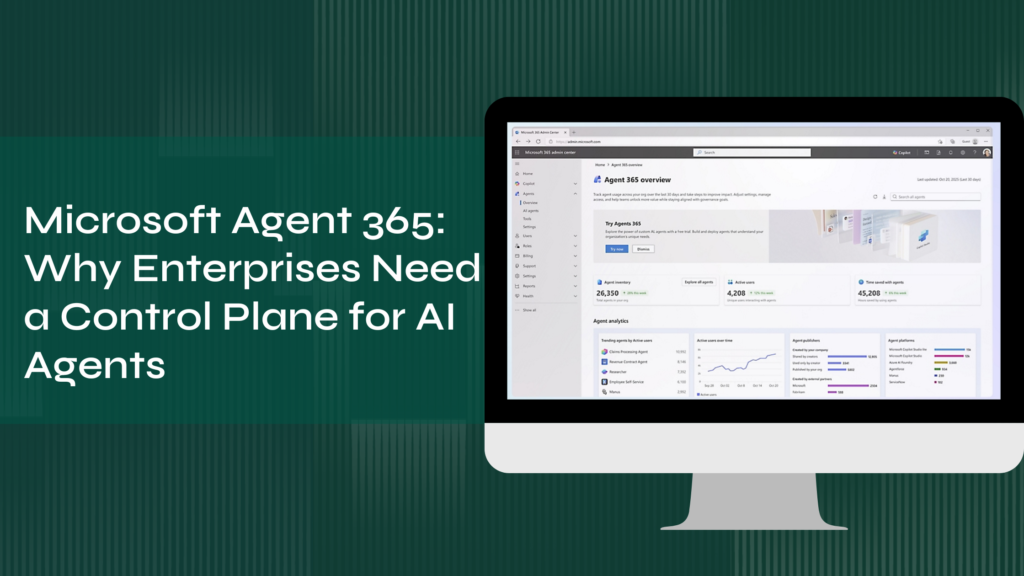
As the number of agents grows, manual oversight stops working. Microsoft Agent 365 was created to deal with that reality. It provides a central control plane for managing AI agents with the same discipline organisations already apply to identities and devices.
In many ways, its role mirrors Microsoft Entra for identity or Intune for endpoints. It gives organisations answers to questions like:
- Which agents exist across the environment?
- Who is responsible for them?
- What data and systems can they access?
- What actions are they actually taking over time?
Put simply, Agent 365 is less about building agents and more about keeping them under control as they scale.
Agents as First-Class Identities
The most important design decision behind Agent 365 is how agents are treated. Instead of being managed as background services or applications, agents are treated as non-human identities.
Each agent can be assigned:
- Its own Microsoft Entra Agent ID
- Permissions limited to what it actually needs
- Conditional access policies that respond to risk
This means agents operate inside the same security, compliance, and data protection boundaries as the rest of the organisation. Risky behaviour can be stopped in real time, actions can be audited end to end, and controls are enforced through identity.
What Makes Agent 365 Different From “Agent Dashboards”
Many products offer dashboards that list agents and basic activity. That helps with awareness, but it does not provide control. Agent 365 is different because it is built directly into the systems enterprises already trust for governance, including Microsoft Entra, Purview, Defender, and the Microsoft 365 Admin Center.
Because of that integration, organisations can do more than observe.
Agent 365 can:
- Approve agents before users gain access
- Monitor risk continuously while agents are running
- See how agents interact with each other
- Identify agents with no clear owner or those created outside approved platforms
These controls apply regardless of how an agent was built, whether through low-code tools, pro-code development, or third-party platforms.
Conclusion
Autonomous agents change the shape of enterprise AI. Once agents can act independently, persist over time, and interact with business systems, they need structure, ownership, and clear boundaries.
Agent 365 introduces that structure. It allows organisations to govern agents in the same way they already govern users, applications, and devices, without forcing the business to slow down or route everything through IT. Teams can deploy agents with confidence, while IT keeps visibility and control where it matters.